The Official Cannabis Independent strain guides
The Official Cannabis collection · sheet 66No 66 · Papaya PunchUniverse

The Papaya Punch universe

The Pan Tuner

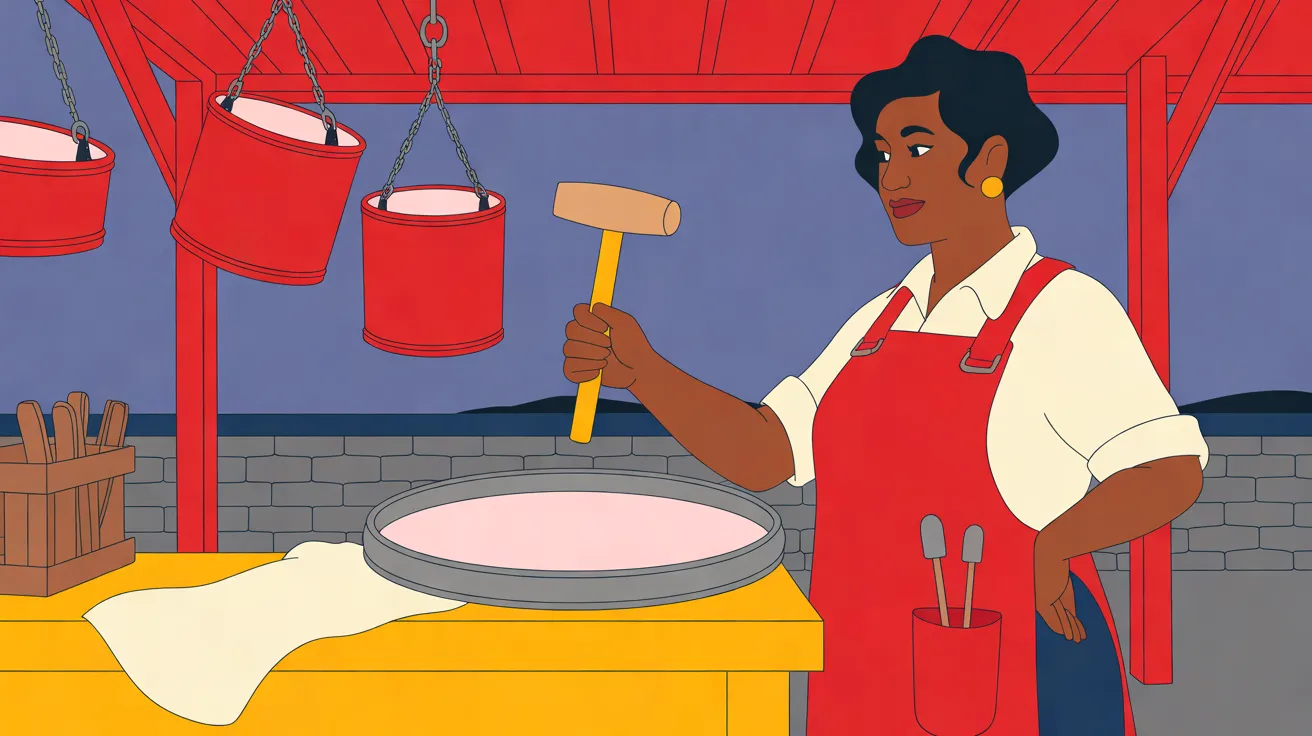
If Papaya Punch is your strain, this is your sign: the Pan Tuner. The open shed at the end of the seawall at dusk, red drums turning on their chains, and you at the bench with the small hammer, waiting for the breeze to bring the last note down.

The Pan Tuner, a woman with dark brown skin, short wavy black hair and gold stud earrings, in a red apron over a cream short-sleeved shirt, stands at the right with one hand on her hip and raises a yellow-handled wooden mallet over a wide, shallow steel drum with a pale pink face on a yellow workbench. Three red drums with pale pink faces hang on chains from the red beams of the open-sided shed, and a wooden crate of sticks and a cream cloth sit on the bench to the left. Behind her a gray stone seawall and a dark strip of sea lie under a plain lavender-blue sky.
The drums turn on their chains and the breeze comes in off the water.

If Papaya Punch is your strain

You hear it before anyone else does: the one note that is a hair sharp, the one the rest of the room has already decided is fine. You do not make a fuss. You pick up the small hammer, tap twice, and wait, because steel tells the truth once it has cooled, and you are prepared to wait for the truth.

You work in short, patient strokes. A tap, a listen, a tap. People who watch you for a minute think you are doing nothing; people who watch you for an hour see a drum slowly agree with itself. Your tools live in the same pockets every day, the punch on the left and the sticks on the right, and you can find the chalk in the dark.

At your best you are the reason the music sounds sweet and nobody knows why. The band plays, the square fills, someone says the drums have never sounded better, and you are already walking home along the seawall with the hammer in your apron, pleased in a way you would never say out loud. Sweet is not loud, you think. Sweet is in tune.

Your flaw is the last note. You cannot leave it. The band is waiting, the light is going, everyone else would call it done, and you are still crouched over the drum with your head on one side, listening for something a hair off. The people who love you have learned to bring a second bucket to sit on and wait with you. It is usually worth it. They will not tell you that.

What you need is an open shed by the water, a bench that does not wobble, a crate of something ripe by the door and the evening breeze arriving off the sea on time. Give you that, and every note finds its place.

Your sign at a glance

Your hour
Dusk, when the breeze turns
Your place
The open shed at the end of the seawall
Your object
A small hammer with a worn handle
Your tempo
Tap, listen, tap
Your weather
An evening breeze off the sea
Your flaw
The last note

Your people

  • The Funky Gourmet (Blue Cheese)The Funky Gourmet books the band for every party and always asks for one more song. You tune the drums; he tunes the room. Neither of you has ever left early.
  • Cindy at Midnight (Cinderella 99)Cindy races the clock tower to the last stroke; you wait for the breeze to the last note. You both know exactly when the hour turns, and you are the only two who never look.
  • The Aurora Keeper (Northern Lights)The Aurora Keeper waits for the sky to light; you wait for the steel to settle. She says patience is a lantern, you say it is a hammer, and you are both right.

Things you say

  • Wait for the breeze.
  • The punch draws the lines. The hammer finds the notes.
  • Warm steel tells you what you want to hear. Cool steel tells you the truth.
  • Every drum has one note that wants to argue.
  • Sweet is not loud. Sweet is in tune.

A scene from your world

The last note before dark

The Pan Tuner’s shed stands at the end of the seawall, where the town runs out of street: an open-sided room under a red tin roof, with the sea on three sides and the market at its back. By late afternoon the finished drums hang from the rafters on their chains, a dozen of them, red skirts and chrome faces, catching the low sun and throwing it in circles on the ceiling. The band comes for them at dark. One is still on the bench.

She has been at it since noon. The face of the drum is chalked into its notes, a ring of soft shapes like the slices of a cut fruit, the low notes around the outside and the small high ones in the middle, and every note but one is sweet. The one in the middle is sharp. Not much. A hair. She taps it with a stick, the shed answers, and the answer is a hair too bright, and she frowns at it the way you frown at a clock that runs two minutes fast.

She knows what it is. The steel is still warm from the day, and warm steel sings sharp. She could hammer it down now, one tap and then another, and it would be right for an hour and wrong by morning. So she does the hardest thing in the trade. She lays the hammer down, slides the crate of papayas to one side, sits on an upturned bucket with her hands in her apron, and waits.

The market packs up behind her. Shutters come down; a cart of empty crates rattles home along the seawall; the fishing boats come in low in the water. The sun goes into the sea the color of the inside of a papaya, and the sky goes red, then amber, then a red so deep it is nearly ink. Then, right on time, the breeze turns. It comes in off the water, cool for the first time all day, and moves through the shed, and every drum on every chain turns a little on its hook, and twelve chrome faces flicker.

She gives it ten minutes. Then she picks up the stick and taps the middle note once, and the answer is right: not bright, not dull, sitting exactly where the other notes said it should. She taps it again to be sure. Then, because nobody is watching, she plays the whole drum once, low to high, a run like water climbing a stair, and the drums overhead hum along on their chains.

The band arrives along the seawall in ones and twos with their stands. They lift the drums off the hooks and the last one off the bench, and somebody says what somebody always says, that the drums have never sounded better. She nods as if she has not heard. When they have gone she hangs the small hammer on its nail, chalks tomorrow’s name on the bench, and stands at the open side of the shed, listening, as the first note comes back across the water from the square.
The seawall

The shed
An open-sided room under a red tin roof at the end of the seawall, with the sea on three sides. The breeze does half the work here, and it knows it.
The chains
A row of them hangs from the rafters, and the finished drums hang from the chains, red skirts and chrome faces turning a little whenever the wind changes its mind.
The bench
Heavy, scarred and level to the hair. A drum on the bench is a drum that is not finished, and there is always one.
The punch
A short steel punch that draws the lines between the notes before the hammer finds them. It lives in the left apron pocket and nowhere else.
The papaya crate
Left by the door every evening by the last stall in the market. Nobody remembers who started it, and nobody has ever stopped.
The evening breeze
It turns off the sea at dusk, cool for the first time all day, and nothing in the shed is called finished before it arrives.

The Pan Tuner, from every side

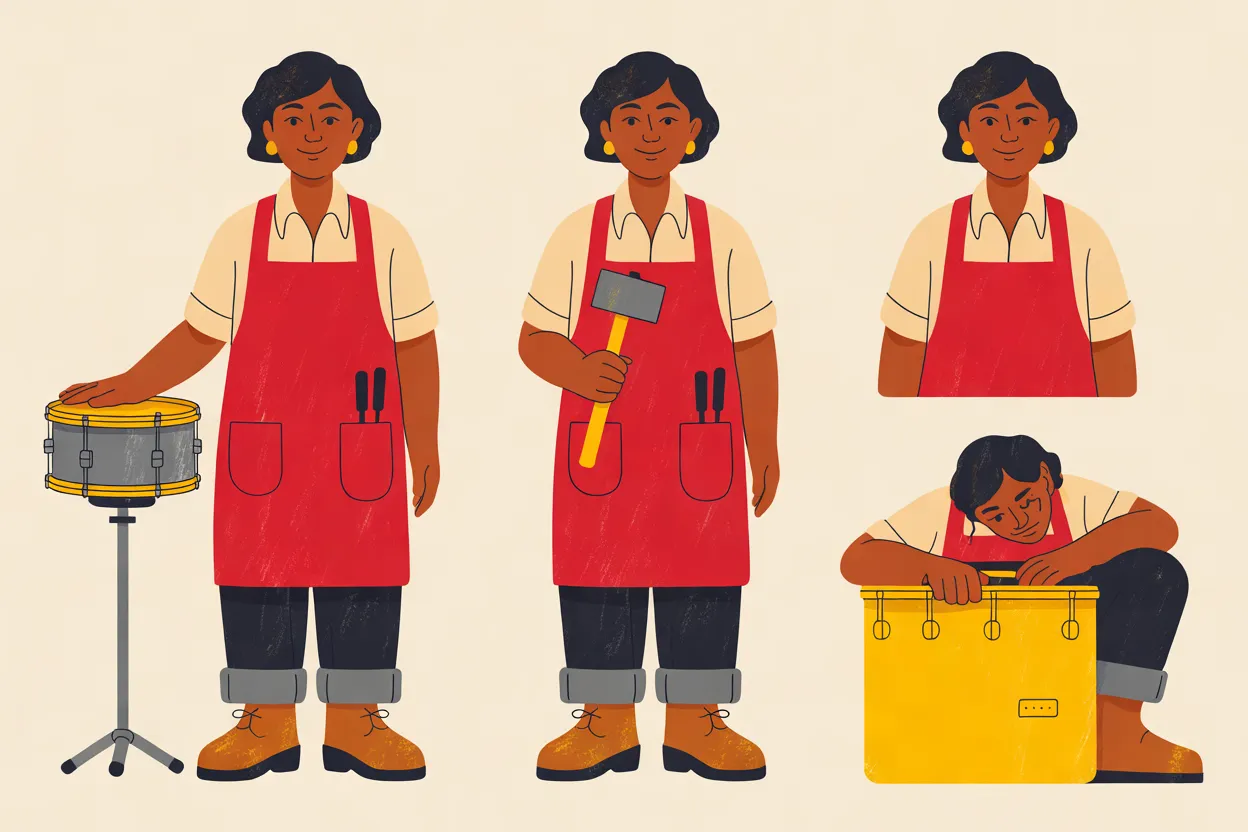
The Pan Tuner character sheet on a warm cream background, in a red apron over a cream shirt, rolled dark trousers and brown boots: a full-body front view with one hand on a drum on a stand, a second full-body front view holding a yellow-handled hammer, a head-and-shoulders close-up, and a crouching view bent over a yellow box with her eyes closed. She has the same closed-mouth smile in both full-body views and the close-up.
The Tuner from every side: apron, hammer and punch, and two faces of the last hour of light: the small smile when a note comes true, and her eyes shut over the yellow case, listening.

An original character, created for Papaya Punch by Official Cannabis. Art direction by Official Cannabis.

Wear the sweet note

Pieces from this world come on a tee, a hoodie, stickers, a mug and a print.